You make money with expired domains by buying authority that took someone else years to earn, for less than it would cost you to build it. There are four ways to turn that authority into income, and one of them now has a published price list: Outrank's marketplace pays a publisher $1 per Domain Rating point for every sponsored article placed on their site. A DR 40 site is paid $40 an article. A DR 60 site is paid $60.
That one number changes how you read a list of expiring domains. A name with DR 45 is no longer just "a strong domain". It is a site that, once rebuilt, has a posted rate.
Finding that name is the hard part, and it is the part we do every day. Below: the math, the four routes, what it costs, and the catch nobody puts in the thread.
The offer that put a price on Domain Rating
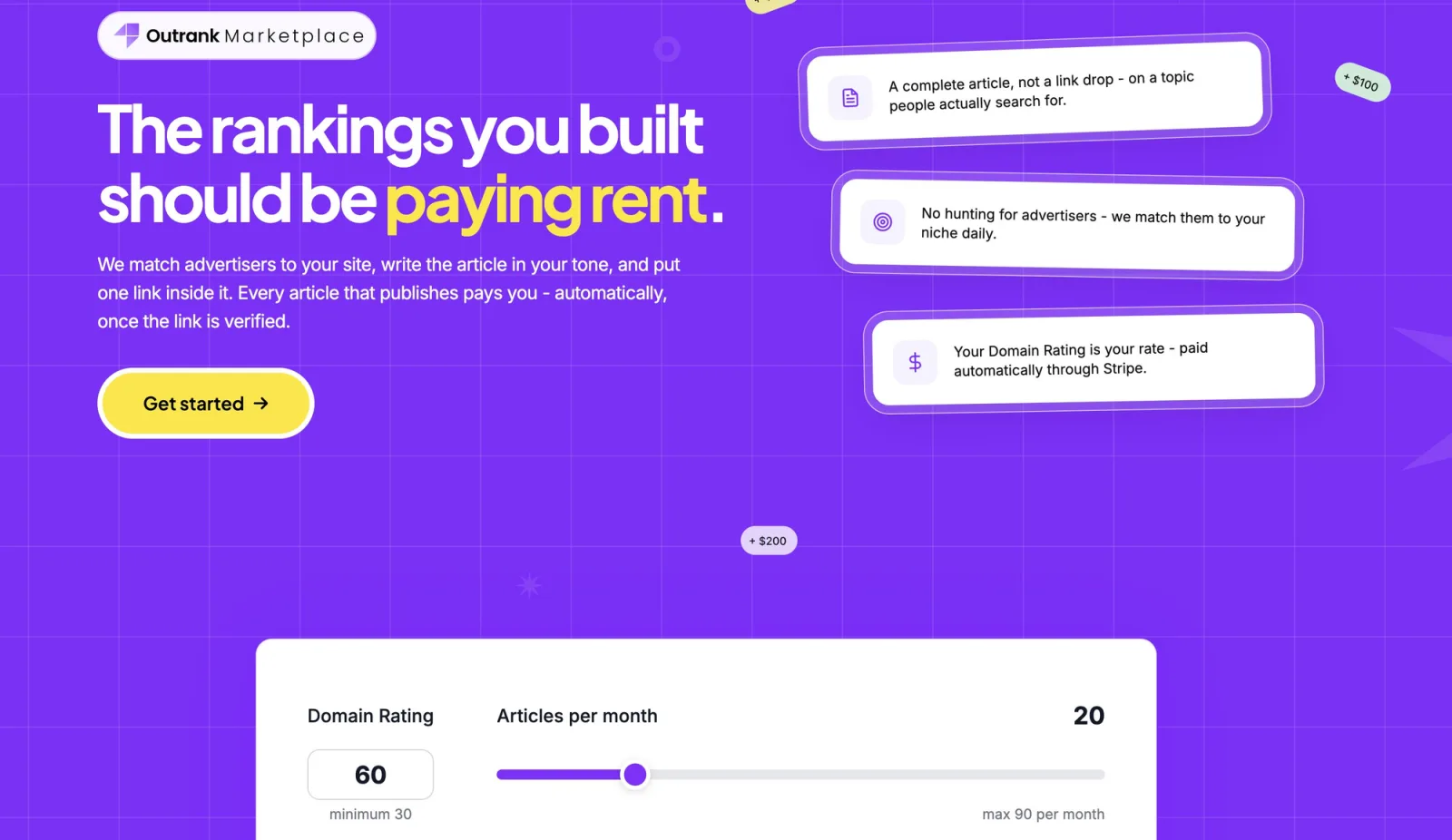
Outrank is an SEO content platform. Its marketplace matches advertisers with blogs: Outrank writes a full article for your site, the advertiser gets one link inside it, and you are paid once the link is verified. These are the terms on its publisher page at the time of writing (check the current ones before you plan around them):
- Rate: $1 per DR point for every published article. Domain Rating is the 0–100 score Ahrefs gives a site's backlink profile.
- Entry bar: DR 30 or higher, at least 100 organic clicks a month, and Google Search Console connected with three or more months of history.
- Your site: a blog on your own domain, on a platform it can publish to (WordPress, Webflow, Ghost and others, or a webhook).
- Payout: an automatic Stripe transfer 14 days after the link is verified.
- Ceiling: up to 90 articles a month, three a day. You can set a lower cap, and a review mode lets you approve every placement.
- No floor: the page says it plainly. There is no guaranteed minimum, and demand in your niche and language sets the volume.
We have no relationship with Outrank. It is simply the clearest public example of something link buyers have always done quietly: pay by authority.
Here is the arithmetic at the published rate.
| Site's DR | Per article | 5 articles a month | 10 articles a month | 20 articles a month |
|---|---|---|---|---|
| 30 | $30 | $150 | $300 | $600 |
| 40 | $40 | $200 | $400 | $800 |
| 50 | $50 | $250 | $500 | $1,000 |
| 60 | $60 | $300 | $600 | $1,200 |
The post that started this conversation ran the same sum across a small portfolio: five sites at DR 40, ten placements a month each, $2,000 a month. Read that as a ceiling you can calculate, not as a forecast. The rate is fixed. The volume is not.
Why an expired domain is the shortcut
DR measures links from other sites, and links are slow. A new blog can publish well for a long time before its DR reaches 30. An expired domain that used to be a real business, a magazine or a community site may still have hundreds of sites linking to it, and whoever registers it next inherits that profile on day one.
That is the whole trade. You are not buying a name. You are buying the years.
It is also where the shortcut ends. The rate depends on DR, but the entry bar has two more parts that no auction can sell you: real organic clicks, and three months of Search Console history under your own account. The social media version of this plan says to wait a couple of weeks. The program's own page says three months. Plan in quarters, not weekends.
Four ways to make money with expired domains
Sponsored placements are the newest route, not the only one. The same revived domain can earn in four ways, and the strongest plans stack two of them.
1. Sponsored articles on the rebuilt site
Rebuild the site on its old subject, earn back some search traffic, then accept paid placements through a marketplace or directly from advertisers in the niche. Income scales with DR and with how many placements the niche really demands.
2. Links for your own projects
If you already run a site, a relevant aged domain is worth what you would otherwise pay for the same links. There are two honest versions: a 301 redirect when the old site and yours are truly about the same thing, or a rebuilt site that links to your project where a reader would expect it. A few relevant links from a real, revived site are worth more than a pile of them from a network built to deceive.
3. The site itself
A domain with history can rank sooner than a blank one when the topic matches. A niche site on an aged domain earns the ordinary way: ads, affiliate programs, leads. It is slower than a placement fee, and it compounds.
4. Resale
Buyers pay for metrics. A clean name bought cheaply can be sold on to an agency or a site builder who has no time to hunt. Domain flipping has thin margins and slow turnover, but it needs no content at all.
| Route | What you need first | When money arrives | Main risk |
|---|---|---|---|
| Sponsored articles | Rebuilt site, traffic, DR 30+ | After months of history | Paid-link rules, uneven demand |
| Links for your own site | A real topical match | When rankings move, if they do | Off-topic redirects get ignored |
| The site as an asset | Content worth reading | Slowly, then steadily | The time before it pays |
| Resale | A clean name and a buyer | On the sale | Holding names nobody wants |
What it actually costs
Three bills, and only the first one comes with an invoice.
The domain. Prices run from a registration fee to four figures, and DR alone does not set them. Names that reach a busy auction get bid up. Names nobody backordered fall through to closeouts, and some drop completely and sit unregistered, where the only cost is a normal registration. What expired domains cost breaks down each channel.
The rebuild. Links point at specific old URLs. To keep them working you rebuild the most-linked pages on their original addresses, with new, original content on the same subject. Budget for the pages that hold most of the links, not for the whole old site.
The wait. Three months of Search Console history is a hard gate on the marketplace route, and traffic rarely comes back faster than that anyway.
A worked example, with numbers chosen for round arithmetic: say you win a DR 40 domain for $200 and spend another $200 on content. At the published rate, ten placements return the outlay. Whether ten placements take two months or ten depends on demand you do not control. That is why the price you pay for the domain matters more than any other number in the plan.
The part that decides everything: which domain
Two domains can both show DR 40. One was a regional hiking club for fifteen years. The other was a hiking club for eleven years and a casino for four. The first can be rebuilt and will survive a review. The second is a liability with a number attached.
DR does not see that difference. It ignores topic, traffic and spam, and it can be inflated on purpose with links that disappear after the sale. The work is in the checking: read the archive across the years, find the moment a site changed language or subject, test the name against spam blacklists, look at who really links to it.
Done by hand, that means downloading auction feeds, pulling DR for thousands of rows and opening archive snapshots one domain at a time. Every version of this plan waves that step through in a single line. It is the step where the money is made or lost.
It is also exactly what hunter.domains does every day. On 6 October 2026 the scan read 2,656,148 expiring and auctioned domains across seven sources. 426 passed the authority pre-filter, and after the history review 62 were on the live list, with an average DR of 36. Everything with a gambling, pharma or adult past, a hijacked history or a link-network footprint was thrown out before the list existed.
For every domain that survives you get:
- a 0–100 score, with DR, Trust Flow, referring domains and archive years side by side;
- risk flags that are shown, not hidden: inflated DR, parked period, topic changed, language changed, archive gap, trademark risk, not in Google;
- the revival kit: the domain's old URLs and archived content, which is the map the rebuild needs (for the day's open domains on a free account, for every domain on Pro);
- on Pro, the Available now list: dropped domains that passed every check and that nobody has registered yet, so the price is a registration fee;
- on Pro, alert rules: a domain above your DR threshold and under your price ceiling reaches your inbox while the auction is still open.
Five domains a day are open on the live list, with their full reports once you create a free account. If you already have a name in mind, the domain checker runs the same report on it, and the DR checker tells you in seconds whether a batch of names clears the 30 line.
The catch: Google's rules
This is the section the excited version leaves out, and it decides whether the income lasts.
Paid links. Google's spam policies treat buying or selling links for ranking purposes as link spam. The same policy says that paid links are a normal part of the web and are not a violation when they carry rel="sponsored" or rel="nofollow". So the question to settle before you join any marketplace is which attribute its links use. Outrank's publisher page did not say when we read it. Ask, and decide knowing that a site full of unqualified paid links can lose the trust that made it worth paying for.
Expired domain abuse. Google's policy targets domains bought and repurposed "primarily to manipulate search rankings by hosting content that provides little to no value to users". A former charity site that comes back as forty sponsored posts and nothing else is the textbook case. A site that returns on its old subject, with pages someone would choose to read, and carries some sponsored articles among them is a different thing. What the policy allows and bans draws the line in detail.
No guarantees. Demand is uneven, programs change their terms, and DR falls when linking sites clean up dead links. Treat every placement fee as a bonus on a site that would be worth owning without it.
A realistic first 90 days
- Weeks 1 and 2. Pick a subject you can write about. Watch the list for clean domains in it with DR 30 or higher, and fix a price ceiling before you bid.
- Week 3. Buy one. Not five. Put it on hosting and connect Search Console the same day, because the three-month clock starts there.
- Weeks 3 to 6. Rebuild the most-linked old URLs with new content on the old subject. Redirect or retire the rest.
- Weeks 6 to 12. Publish steadily and watch clicks climb toward the hundred-a-month line.
- Month 3 onward. Apply for placements, in review mode. Then decide whether a second domain is worth buying with what the first one taught you.
The people who do well at this are not the ones with the best spreadsheet. They are the ones who see the right domain on the day it is available, and can tell it apart from the forty that only look right.
Frequently asked questions
Can you really make money with expired domains?
Yes, but the domain is the raw material, not the product. Income comes from what you build on it: sponsored placements, a site that earns from its own traffic, link support for a project you already run, or a resale. None of it is passive in the first months, and none of it is guaranteed.
How much does Outrank pay per article?
At the time of writing its publisher page states $1 per Domain Rating point for every article published on your site, so a DR 40 site is paid $40 an article. It requires DR 30 or higher, 100 or more organic clicks a month and three months of Search Console history, and it does not guarantee any number of placements.
How long until a revived domain qualifies?
Plan for at least three months. The Domain Rating comes with the domain, but the organic clicks and the Search Console history have to be earned on the rebuilt site, under your own account.
Is selling links on an expired domain against Google's rules?
Selling links that pass ranking credit counts as link spam under Google's policies. Paid links marked rel="sponsored" or rel="nofollow" are allowed. Separately, reviving a domain only to host low-value content breaks the expired domain abuse policy, so the site has to be useful in its own right.
Via @oozn
